

Manga vs. Anime Styling in Naruto Collectibles
Naruto has 250 million manga copies in circulation worldwide. The anime ran 720 episodes across two series from 2002 to 2017. Two versions of the same story, the same characters, and completely different visual languages. Series background at Wikipedia — Naruto.
Those visual differences follow through into physical collectibles. A manga-inspired Naruto collectible and an anime-inspired one aren’t just stylistic alternatives — they communicate different things about the character and the era. The Naruto Toys lineup is one concrete example of how anime-accurate design works in practice.
This article breaks down the design differences between the two styles, shows how they apply to specific characters, and helps you decide which approach suits what you’re going for.
The Source Materials: What Makes Them Different

The manga
Masashi Kishimoto drew Naruto for 15 years in Weekly Shōnen Jump. The manga uses black, white, and gray with screen tones to convey depth. Kishimoto’s art evolved significantly — early Naruto featured rounded, loose character designs. By Part II and the war arc, his linework became sharper and more anatomical. Character reference at the Naruto Fandom — Naruto Uzumaki.
Static panels. Motion implied by speed lines, exaggerated perspective, and heavy inking during high-emotion moments. The manga design prioritizes emotional accuracy over visual spectacle.
The anime
The anime standardized character designs for consistent use across 720 episodes. Where Kishimoto’s manga art is a moving target that evolved across 700 chapters, the anime locked in specific visual identities — Naruto’s orange, Sasuke’s dark blue, Kurama’s orange-gold.
Colors are bold and saturated. Poses are action-forward. Effect parts (chakra glows, lightning, wind spirals) are key visual identifiers that the manga depicts differently.
The anime’s version of Naruto isn’t wrong or simplified — it’s purpose-crafted for a different medium. But the result is a different character design language.
Manga vs. Anime Styling: Side-by-Side Comparison
|
Design feature |
Manga style |
Anime style |
|
Color palette |
Black, white, gray. Ink shading for depth. Occasional full-color covers. |
Full standardized color across every character. Bold, saturated tones. |
|
Pose type |
Static but impact-heavy. Speed lines and panel framing imply motion. |
Dynamic. Mid-action. Weapons drawn, chakra effects extended. |
|
Design stability |
Kishimoto’s style shifted significantly across 700 chapters. |
Standardized for animation consistency across 720 episodes. |
|
Shading method |
Cross-hatching and heavy inking for shadow and emotion. |
Flat color fills with clean outlines. Color saturation creates depth. |
|
Detail focus |
Fine linework, anatomical accuracy, expressive detail in face and clothing. |
Clear, readable silhouettes optimized for motion and screen. |
|
Effect representation |
Implied through composition and kinetic lines. |
Physical effect parts: translucent plastic, glow elements, chakra shapes. |
|
Display mood |
Source-material reference. Contemplative, ink-art aesthetic. |
Battle-frozen. High energy. Screen-ready visual presence. |
What Manga Styling Looks Like in Physical Collectibles

Manga-style collectibles are less common than anime-style ones. They lean toward sculpt over gimmick — no translucent chakra parts, no light-up features. The focus is on accuracy to Kishimoto’s specific linework and shading.
- Color palette — muted or grayscale-inspired. Some manga-style pieces use a limited palette that approximates the watercolor covers Kishimoto produced for the series.
- Pose type — usually more restrained. A standing or slightly angled pose rather than a mid-combat freeze.
- Detail emphasis — fine surface texture on clothing, hair, and facial features. The goal is to look like the panel pulled into 3D rather than the screen pulled into 3D.
- Audience — source material purists. Fans who came to the series via manga first.
- Production volume — typically produced in smaller quantities than anime-style equivalents. More niche, often more expensive.
What Anime Styling Looks Like in Physical Collectibles
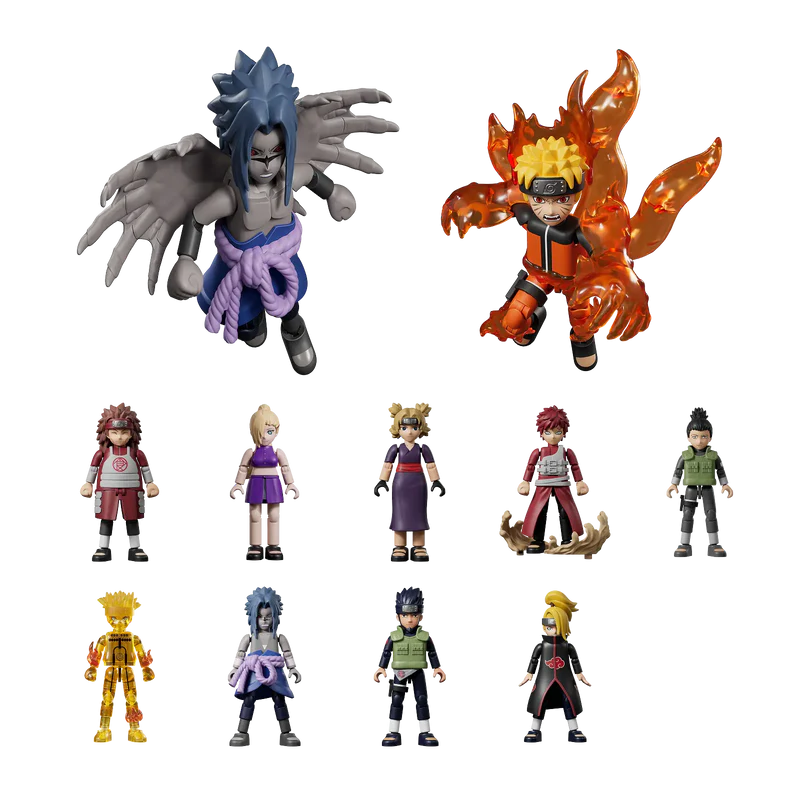
Anime-style is the dominant approach in Naruto collectibles and for good reason. The standardized color identities (Naruto’s orange, Sasuke’s dark blue, Kurama’s warm gold) are what most fans picture when they think of these characters.
- Color palette — vibrant and saturated. The specific Shippuden-era color assignments for each character.
- Pose type — action-forward. Rasengan extended, Chidori sword drawn, tails spread. Captured in a specific battle moment.
- Effect parts — translucent plastic for chakra and energy effects, light-up features, poseable impact accessories.
- Articulation — interchangeable faces and hands let collectors shift between battle expressions and neutral displays.
- Audience — the majority of the fanbase. Anime-first fans. Collectors who want to recreate specific moments from the series.
- Production volume — much higher than manga-style. Broader retail access at multiple price points.
Character Style Comparisons

The same character looks different depending on which source you’re drawing from. Here’s how the three most collected Naruto characters diverge.
|
Character |
Manga visual signature |
Anime visual signature |
|
Naruto Uzumaki |
Weathered expressions. Heavy inking on Sage Mode markings. Rounded-to-sharp evolution across Part I and II. Emotional rawness in facial detail. |
Bright orange jumpsuit. Blue Rasengan glow. Mid-air action stance. Kurama chakra cloak in Six Paths form. Immediately recognizable at a distance. |
|
Sasuke Uchiha |
Muted, anatomically lean. Heavy shadow on Cursed Mark and Akatsuki cloak. Sharp, hollow expression. Internal conflict in the detail. |
Dark blue color signature. Chidori lightning. Susanoo ribs or wings in Shippuden forms. High visual impact. Cool-factor emphasis. |
|
Kakashi Hatake |
Tactical restraint. Fine flak jacket texture. Headband and mask detailing. Precision line detail on his gear. |
Lightning Blade blue glow. Sharingan eye visible. Speed-forward poses. The iconic mask is more character-defining in anime color. |
Where the Blokees Naruto Lineup Sits

The Naruto Champion Class and Legend Edition series take the anime-accurate approach. These are Shippuden-era designs — officially licensed Naruto Shippuden IP, canonically accurate to the anime’s visual treatment of each character.
The Naruto Champion Class Naruto Uzumaki (CC02) uses the Shippuden-era color identity — the orange jumpsuit, Rasengan blue, effect cloud accessories. These aren’t manga-accurate designs. They’re anime-accurate.
The Naruto Shippuden Legend Edition Kurama (Nine Tails) takes this further. The magnetic light-up Tailed Beast Ball feature and nine independent poseable tails are explicitly anime-inspired design decisions — references to how the anime depicted Kurama’s power visually, not how it appears in black-and-white ink.
The Naruto Official Website has more on the Shippuden IP licensing and character designs if you want the original source context.
Which Style Is Right for Your Collection?

Depends on why you’re collecting and what you remember most about the series. Honest answer: there’s no wrong choice. Both styles are legitimate. The question is what you’re going for on a shelf.
|
If you want... |
Choose manga styling |
Choose anime styling |
|
Original source fidelity to Kishimoto’s art |
✓ |
|
|
A battle scene frozen in a specific Shippuden moment |
✓ |
|
|
Muted color palette for a sophisticated display |
✓ |
|
|
Dynamic poses with effect parts and accessories |
✓ |
|
|
Collectibles that read immediately on a desk |
✓ |
|
|
Characters that evolve in design across your display |
✓ |
|
|
Effect accessories (Rasengan, Chidori, chakra) |
✓ |
|
|
Interchangeable faces and poseable joints |
✓ |
Can You Mix Both Styles?

Yes. There’s no rule against it. A manga-accurate statue at the back of a shelf with anime-accurate poseable kits in front is a coherent display as long as you’re intentional about it.
The contrast can work well. A static manga-style centerpiece surrounded by dynamic anime-accurate poses creates visual variety. The key is keeping the scale and height consistent so one style doesn’t visually dominate the other for the wrong reasons.
- Avoid mismatched scale — a small manga-style piece next to a large anime-style centerpiece gets lost. Keep heights comparable.
- Use era as your organizing principle — Part I designs in one section, Shippuden designs in another. Both styles look more coherent when grouped by arc.
- Reserve the premium spot — whichever style you prefer, put the highest-quality piece at the rear center. Everything else reads as context around it.
Caring for Both Style Types

General rules
- UV exposure — warm tones fade fastest. Naruto’s orange and Kurama’s gold are particularly sensitive. Direct sunlight is the main risk for both styles.
- Dusting — dry soft brush for articulated anime-style kits. Cloths snag on joint edges. Manga-style static pieces are easier to dust but benefit from the same brush approach.
- Joints (anime-style kits) — POM joints hold tension better when repositioned occasionally. Don’t lock a poseable kit into one position for months.
- Interchangeable parts storage — face sculpts and hand sets for anime-style kits. Keep them in the original tray or a labeled container when not displayed.
Conclusion
The manga-versus-anime styling debate in Naruto collectibles isn’t really about which is better. It’s about which visual language connects more directly to your experience of the series.
Manga-style: source material fidelity, muted depth, ink-art aesthetics. Anime-style: vibrant presence, battle-frozen energy, immediate character recognition. Both are legitimate ways to have Naruto on your shelf.
Full Naruto lineup at Blokees.
FAQs
What is the main difference between manga and anime styling in Naruto collectibles?
Manga styling prioritizes Kishimoto’s original ink-heavy art: muted palette, static poses, fine linework, and emotional depth through sculpted expression. Anime styling uses the standardized Shippuden color identities: vibrant colors, action poses, and effect accessories.
The practical difference on a shelf: manga-style pieces tend to look more like a reference to the source art. Anime-style pieces look like a frozen frame of a battle scene. Different moods, both legitimate.
Which style is more accurate to the original Naruto?
Manga styling is closer to Masashi Kishimoto’s original artwork. The anime adapted and standardized the designs for animation — simplified in some areas, enhanced visually in others. Neither is more ‘correct’; they’re different interpretations of the same IP.
For strict source material accuracy, manga-style. For what most fans picture when they think of Naruto Shippuden, anime-style.
Why are anime-style Naruto collectibles more common than manga-style?
The anime fanbase is larger than the manga readership for most Western markets. More demand = higher production volume = easier retail access. Manga-style pieces tend to be produced in smaller runs for a more niche collector audience.
Anime-accurate design is also easier to standardize at scale. The color assignments and character silhouettes are fixed across thousands of animation frames, making them straightforward for manufacturers to license and replicate accurately.
Do officially licensed Naruto kits use anime or manga styling?
Most officially licensed Naruto kits — including the Blokees Naruto Champion Class and Legend Edition series — use anime-accurate Shippuden-era designs. These are the standardized color identities and character designs from the anime production.
Manga-accurate collectibles exist but are typically in the premium or limited-run categories. The Blokees lineup is explicitly anime-accurate and Shippuden IP licensed.
How does Naruto Uzumaki look different in manga vs. anime styling?
Manga-style Naruto emphasizes weathered facial expressions, heavy ink on Sage Mode markings, and the evolution from Part I’s rounder design to Part II’s sharper anatomy. Less orange. More emotional weight in the face detail.
Anime-style Naruto is defined by the orange jumpsuit, bright blue Rasengan, and mid-combat pose. Immediately recognizable. The Shippuden-era color identity is the version most fans default to when thinking of the character.
How does Sasuke Uchiha look different in manga vs. anime styling?
Manga-style Sasuke uses heavy shadow and lean, anatomical design. His Akatsuki-period designs in the manga are distinctly muted — dark cloaks, hollow expression, internal conflict communicated through shading.
Anime-style Sasuke is defined by his dark blue color signature, the Chidori lightning effect, and Susanoo visual forms in Shippuden. High cool-factor emphasis that the manga depicts differently through linework.
Can I mix manga and anime styled collectibles on the same shelf?
Yes. Use era as your organizing principle — Part I on one side, Shippuden on the other. Keep heights comparable so one style doesn’t dominate visually for the wrong reasons.
The contrast can actually work well as an intentional display choice. A manga-accurate static centerpiece with anime-accurate poseable kits in front is a legitimate setup.
What does ‘anime-accurate’ mean in a Naruto kit context?
Anime-accurate means the character design, color assignments, and accessory choices match the specific visual treatment from the Naruto Shippuden anime production, not the manga panels.
Concretely: Naruto’s specific orange, Sasuke’s specific dark blue, Kurama’s gold-orange, and effect accessories (Rasengan, Chidori, Tailed Beast Ball) that reference how those techniques appeared on screen.
Are manga-style Naruto collectibles harder to find?
Generally yes. Manga-specific design variants are less common because the market for them is narrower. They tend to appear in premium or specialty tiers rather than standard retail.
Anime-style Naruto collectibles have broader retail access at multiple price points. The Blokees Champion Class line at $19.99 per kit is an example of anime-accurate design at accessible pricing.
What is the Blokees approach to Naruto character design?
Blokees uses anime-accurate Shippuden-era designs. All kits in the Naruto Champion Class and Legend Edition series are officially licensed under the Naruto Shippuden IP, with character designs that match the anime’s color and visual standards.
The emphasis is on poseable articulation, interchangeable expression and hand parts, and included accessories that reference the anime’s visual treatment of each character’s techniques.
Sources
- Wikipedia — Naruto — Series overview including manga and anime production history, circulation data. Ongoing updates.
- Naruto Fandom — Naruto Uzumaki — Character reference including design documentation. Ongoing updates.
- Naruto Official Website — Official Naruto IP source. Ongoing updates.
- Naruto Toys Collection — Blokees — Official Naruto IP main collection.
- Naruto Champion Class Collection — Blokees — Official Champion Class series page.
- Naruto Champion Class 02 Naruto Uzumaki — Blokees — Official product page. Anime-accurate Shippuden design confirmed.
- Naruto Champion Class 04 Sasuke Uchiha — Blokees — Official product page. Anime-accurate design confirmed.
- Naruto Shippuden Legend Edition 01 Kurama (Nine Tails) — Blokees — Official product page. Anime-accurate Shippuden IP licensing confirmed.
- Naruto Champion Class 03 Minato Namikaze (Reanimation) — Blokees — Official product page. Reanimation design — Shippuden-era canon confirmed.


Looking for something else?
Which Marvel Rivals Blokees Kit Should You Assemble First?
LEARN MORE
Best X-Men Model Kits: Wolverine, Magneto, and More
LEARN MORE
How to Assemble Blokees Marvel Rivals Spider-Man
LEARN MORE
Unboxing the Blokees Marvel Rivals Champion Class Series
LEARN MORELooking for something else?
Dynamic Posing Guide: How to Make Spider-Man Swing
LEARN MORE
Secret Rares Revealed: Blokees Marvel Rivals Hidden
LEARN MORE
How to Create a DIY Marvel Rivals Battle Diorama Display
LEARN MOREYou may also like


Further reading

Blokees EVANGELION Gift Guide: Choose by Character, Unit, and Display Format

EVANGELION 30th Anniversary: How the Series Continues to Reach Audiences